Wednesday, June 18, 2014

He falls even lower

BULLY BOY PRESS &     CEDRIC'S BIG MIX -- THE KOOL-AID TABLE

ANOTHER WEEK, ANOTHER BAD POLL FOR BARRY O.

FADED CELEBRITY IN CHIEF BARRY O CONTINUES TO SUFFER FALL OUT FOR SURRENDERING 5 TALIBAN LEADERS.

A NEW WALL STREET JOURNAL - NBC POLL FINDS 44% OF AMERICANS ARE OPPOSED TO THE TALIBAN DEAL WHILE 30% SUPPORT IT.


THE POLL ALSO FOUND THAT 57% OF AMERICAN DISAPPROVE OF BARRY O'S HANDLING OF FOREIGN POLICY WHILE ONLY 37% APPROVE.

REACHED FOR COMMENT BY THESE REPORTERS, BARRY O INSISTED THE POLL DID NOT MATTER BECAUSE HE'D ALREADY COME UP WITH A NEW PLAN (SEE "Barry O re-starts it to be applauded when he pulls out" AND "THIS JUST IN! HE'S CALLING IT A PLAN!").

"WHEN THEY START POLLING ON MY IRAQ PERFORMANCE, I'LL BE BACK ON TOP!  BACK ON TOP!" BARRY O INSISTED LAUGHING MANIACALLY.


FROM THE TCI WIRE:


It was last Wednesday when US Ambassador to Iraq Stephen Beecroft appeared before the Senate Foreign Relations Committee.  He was not there to testify about Iraq.  No, he was present because Barack has nominated him to be the next US Ambassador to Egypt.

Iraq is in turmoil and Barack's trying to pull the Ambassador out and bring in a new one.

What Barack has offered is an ever changing Ambassador to Iraq.

Chris Hill was an utter failure.  We noted he would be before he was confirmed.  A simple look at his personnel file was all anyone needed to grasp the failure Hill would be.  This was who Barack went with for his first Ambassador to Iraq.  After Hill's failures were too big to ignore, Barack then nominated James Jeffrey.  Like Hill, Jeffrey was confirmed.  Unlike Hill, Jeffrey wasn't a non-stop embarrassment in the post. Barack then nominated I'll-stick-my-cock-in-anything Brett McGurk to be the next Ambassador.  He withdrew his nomination when his e-mails about blue balls only further made his nomination seem like a joke. Then Barack nominated Beecroft.

And now he's moving Beecroft to Egypt and has nominated Stuart E. Jones to be Ambassador to Iraq.  Jones currently serves as the US Ambassador to Jordan.

Barack is currently in the sixth year of his presidency.  Jones is Barack's fifth nominee to be Ambassador to Iraq.  Not only does that not instill confidence, it also demonstrates a lack of vision and a lack of consistency in the US government's dealings with Iraq.


In his prepared remarks, Jones noted:

Mr. Chairman, I am both humbled and thrilled to have the opportunity to serve as Chief of Mission at American Embassy Baghdad, one of our largest and most complex diplomatic missions. I had the honor of serving as Deputy Chief of Mission in Baghdad. I also served as the Governorate Coordinator in Ramadi, in Anbar Province under the Coalition Provisional Authority in 2004. Later I was Director for Iraq Affairs on the National Security Council staff here in Washington. These jobs have helped me prepare for the complexity and challenges of the assignment ahead. We are all familiar with the history of Iraq's past decade. It is impossible to serve in Iraq without recalling and honoring the sacrifice and achievement of our U.S. servicemen and women and civilians. More than 4,000 Americans lost their lives to give the Iraqi people a chance at a better future. Today we are committed to helping build a new Iraq, which has moved beyond the isolation and oppression of its past, with secure borders, strong democratic institutions, and where all citizens benefit from its abundant resources.


And that contained the first evidence that Jones isn't up for the job.

I'm sick of these nominees Barack keeps offering who do not value life.  I'm tired of it, their work demonstrates that if they short cut life at their confirmation hearings, they don't suddenly develop a respect for it later on.

"More than 4,000 Americans lost their lives"?

The number of US military personnel the Dept of Defense states died in the Iraq War is [PDF format warning] 4489.

'Well, by Price Is Right showcase showdown rules, Stuart Jones is right!  He didn't overbid!'

I guess that's true, but it's also true that this isn't a game show.

He wants to be Ambassador to Iraq.  He submits the statement he read out loud to the Committee in writing. And he can't get the number right?

He can -- and does -- provide accurate statistics for suicide bombers.  And you should listen to him yack on with oil statistics.  But when it comes to how many US military personnel died in Iraq, he goes all soft and fuzzy.

Again, if you're not interested in human life when you're angling for the position, you don't later develop an affinity for it while performing your duties as Ambassador.

Chair Robert Menendez:  In Iraq, while political leaders are deal making to form a government, the Iraqi people are not benefiting from their country's increased oil output and the conflict continues to surge in western Iraq as the spillover from Syria has enabled the Islamic State of Iraq and Syria to take hold.  Clearly, we must continue to support Iraqi security forces but I'm concerned by reports that they have been using barrel bombs in their operations.  Serious questions remain unanswered: Iraq's role in Syria, the activities of Iraqi Shi'ite militias fighting with Assad's security forces,  the Iranian influence in Iraq and the commitment of the Iraqi government to protect the residents of Camp Liberty until we can conclude a resettlement process. 


Barrel bombs?  Human Rights Watch noted barrel bombs in their May 27th report:

Iraqi government forces battling armed groups in the western province of Anbar since January 2014 have repeatedly struck Fallujah General Hospital with mortar shells and other munitions, Human Rights Watch said today. The recurring strikes on the main hospital, including with direct fire weapons, strongly suggest that Iraqi forces have targeted it, which would constitute a serious violation of the laws of war.
Since early May, government forces have also dropped barrel bombs on residential neighborhoods of Fallujah and surrounding areas, part of an intensified campaign against armed opposition groups, including the Islamic State of Iraq and the Sham (ISIS). These indiscriminate attacks have caused civilian casualties and forced thousands of residents to flee.

“The government has been firing wildly into Fallujah’s residential neighborhoods for more than four months, and ramped up its attacks in May,” said Fred Abrahams, special adviser at Human Rights Watch. “This reckless disregard for civilians is deadly for people caught between government forces and opposition groups.”


Camp Liberty refers to the Ashraf community and they'll be mentioned again in a moment.  Menendez is the Committee Chair, Senator Bob Corker is the Ranking Member.  Corker noted at the top of the hearing, "Iraq, we're continue to read daily, the devolution that is taking place there.  You feel it on the ground.  The lack of -- The lack of involvement that we have had in terms of shaping things on the ground is very, very apparent and I know we'll talk about that during Q &  A."

Along with Beecroft and Jones, the Committee also heard from Dana Shell Smith who's nominated to be the US Ambassador to Qatar. Our focus is Iraq, we won't be addressing her nomination.  We will note she was able to look up frequently as she read her opening remarks because someone took a nomination seriously enough to review their written remarks and probably practice delivering them.  Well done, Shell Smith.

By contrast, Jones badly read from his prepared remarks and ran with Brett McGurk's overused buzzwords such as "holistic approach" to Iraq. The bulk of his statements focused on Iraq's oil.  Oil, oil, oil.

Chair Robert Menendez:  Ambassador Jones, you know, we had Prime Minister Maliki here last year.  It was a difficult meeting.  I don't know whether or not he will actually, uh, be the prime minister again.  I guess by many accounts, he may very well ultimately build the coalition necessary to do that. But, as I said to Ambassador Beecroft as it relates to our relationship with the Egyptian government, in this case, the Iraqis must understand that the use of barrel bombs, that the overflights and the transiting of airspace by Iran sending troops and military equipment into Syria with impunity, and the lives of the people at Camp Liberty until they are resettled is going to be part of what this Committee judges as it relates to future arm sales, as it relates to our relationship.  So I would like to hear from you.  We understand the importance, we honor the lives of those who were lost in pursuit of a more democratic Iraq from the United States and an enormous national treasure.  But there has to be some change in the course of events here including having a government that is more inclusive, in which every Sunnis isn't an 'enemy' of the state.  There are many Sunnis who want to be part of Iraq as a nation but they have to be included as well.  Can you tell me about what you'll be messaging there as it relates to these issues?


Ambassador Stuart Jones:   Thank you, Mr. Chairman.  Let me take your last point first which is, uh, of course, we completely agree, for Iraq to succeed, the different el -- the different political elements, the sectarian groups need to come together and create a shared vision.  They need to create a shared vision for their national security, they need to pull together to address the terrorist threat posed by ISIL and, uh, although the news from Mosul is very bad, I think one, uh, positive aspect of this may be that the groups are indeed coming together to address this challenge.  At least we're seeing signs of that in the last 24 hours.  In regards to the use of barrel bombs, the use of barrel bombs is completely unacceptable.  It's an indiscriminate weapon against civilians and it cannot be tolerated.  This is something that my colleague, Steve Beecroft has raised with the senior levels of the Iraqi government.  There has been an instruction handed down through the military that barrel bombs will not be used.  And we've also heard from military contacts that they recognize that instruction.  In regards to the overflights, this is an issue that remains a problem.  We are concerned that Iran is supplying the Bashar regime with overflights over Iraq.  This is something that we would like to see the Iraqis stop.  And this is, again, something that we have raised at the most senior levels.  And I will continue to do that and look for ways to find a way to stop -- to stop this traffic.  Uhm, on the issue of Camp Liberty, uhm, I know this is an issue of particular concern and it's a very important issue.  When I was the Deputy Chief of Mission in Iraq in 2010 and 2011, uhm, we witnessed a terrible attack on Camp Ashraf in which many people were killed and others were wounded.  I think the steps that we've taken since then have been quite positive, moving the residents of Ashraf to Camp Liberty has improved their security.  The government of Iraq has also responded to our requests and others requests to improve the security around Camp Liberty and that's encouraging.  But the solution, of course, is to remove the members of Mojahedin-e-Khalq from Iraq and get them to a safer place. They will not be safe until they are outside of Iraq and, uh-uhm, our government is taking the lead on this.  The Special Envoy for the Secretary [of State John Kerry], Jonathan Weiner, is meeting with representatives of countries around the world and asking them to take members of the Mojahedin-e-Khalq.  And we also now have a team in Baghdad to interview members to see -- working towards receiving a group of those here in the United States.  And I think this is the best solution that we can present.


Chair Robert Menendez:  Well two final points so that you're crystal clear. I don't want to hear Iraq tell us that we need actionable intelligence.  When we have it, we'll provide it. But they have a responsibility in doing random surveillance of over flights.  And that is an excuse that is unacceptable. Secondly, I agree with you that resettlement of the MEK is the ultimate solution.  I hope -- and I have urged the State Department to consider bringing some of them to the United States as an example to the rest of the world that we're asking to seek resettlement to do so.  But in the interim, I hold the prime minister responsible for the lives of those individuals at the Camp.

Ideally, we'll note more from the hearing in tomorrow's snapshot.  For now, we'll move to an exchange with the Ranking Member.

Ranking Member Bob Corker:  Ambassador Jones, you know, I've visited Ambassador Beecroft and been to Iraq -- like many of us [on the Committee] many times.  Today, when you're there, unlike Jordan where you still are, it feels like a vacant, deserted lot, relative to our emphasis on it.  It feels like we've checked the box and moved on, that we've really lost influence.  That's, I think, everybody acknowledges that. That we really haven't been robust in all levels relative to our efforts there. We had a great conversation yesterday and we talked a little bit about the lack of a SOFA [Status Of Forces Agreement] and the fact that our troops are gone and that's contributed to the lack of influence in a pretty big way.  You've had two tours there.  And I mentioned I was going to bring this up just to kind of set the record straight. Many of us have felt -- and maybe after you say what you say -- may still feel that one of the reasons that Iraq is the way that it is is that we, you know, didn't leave behind some presence and that we actually, this was actually what the administration wanted to occur.  You have a very different perspective on that and I thought, don't take too long, if you will, but I thought it would be good for you to share your thoughts relative to why we do not have a presence in Iraq today.

Ambassador Stuart Jones:  As you said, we spoke about this yesterday.  My view on this is that, uhm, is that the Iraqi people really did not come together and ask us to stay in a way that made it possible for us to stay.  And it's as simple as that.  No secr -- No major Iraqi leaders -- with the exception of the Kurds -- came forward and invited us to stay in a public matter.  And they didn't go on television.  Uhm, we obviously needed to have a Status Of Forces Agreement for the security of our troops and the Iraqis didn't meet us half way on that.  So I think that this was the result of-of-of that negotiation and that's how it ended.

Ranking Member Bob Corker:  And so, from your perspective, the fact that we have no presence there and, candidly, much less influence, uh, is a result really of just the Iraqi people not wanting it to be that way?

Ambassador Stuart Jones:  Yes, sir.

Ranking Member Bob Corker: That's interesting and a very different perspective than I've heard from most but I appreciate your sharing that.  Uhm, and I would agree with the Chairman.  We had a pretty terse meeting with Maliki here.  I'd had one on the ground, just before that. [Menendez, Corker and others met with Nouri in the last week of October of last year.]  He's obviously not been a good prime minister. He has not done a good job of reaching out to the Sunni population which has caused them to be more receptive to al Qaeda efforts.  Uh, obviously the Syrian conflict -- I know there's analysis today saying that that's really not having an impact on Iraq -- I believe it's having a major impact on Iraq.  But with our diminished status in Iraq and the fact that we used to play shuttle diplomacy, if you will, between the Sunnis and Shia and causing that to work in a better way -- I think you did that before in your previous capacity -- how do you view your role there going there now under the circumstances that we have and trying to mitigate some of the problems that exist between the -- especially the Shia and the Sunni.

Ambassador Stuart Jones:  Yeah, uhm, well I think I'm blessed to be following in the footsteps of Steve Beecroft.  I think Steve has established very good relations with all of the groups in Iraq and I think this is a role that we should continue to play -- brokering, using our good offices to broker solutions to the myriad problems that face -- that face Iraq.  I think we've made great progress in recent months in trying to broker an arrangement by which the hydrocarbon, uhm-uh, law could be finalized and the relations between Kurdistan -- the Kurdish Regional Government and Baghdad could resolve their problems.  I think we also could find ways to support a process of political conciliation between some Shi'ite, uh, Sunni groups and, uh, and the government.  This is the role that the United States has played in Iraq in the last ten years and I certainly hope to continue that role.  I think we do have significant influence because of our, uh, continuing presence in the commercial and the petroleum sector as well as continuing presence in the military sector though, obviously, not with troops on the ground.


Are you feeling it for the nominee?

He's well liked in the State Dept and is considered to have shown real skill and talent in Jordan.  But when he says something like "great progress in recent months" on the hydrocarbon issue?  Well it may seem that way to him.  To others, probably not.

I've been hearing that claim in Congressional hearings since 2006.

And there's been no law passed.

And, more importantly, nothing's happening now.  Nor will it happen.

Over the weekend, Parliament held what was their last session.

So you'll have a new Parliament at some point.  (In 2010, it took over 8 months after the parliamentary election for Parliament to have a real session and name a president and Speaker of Parliament and prime minister-designate.)  And the process of discussing a law will start all over.  As it repeatedly has.  And Stuart Jones -- he will be confirmed (and that's not a complaint, he's better than Hill and most think he'll be better than Jeffrey) -- will become the latest Sisyphus to start each day pushing the same rock up the hill.


RECOMMENDED:  "Iraq snapshot"
"Wesley Clark, voice of Big Oil, wants US airstrike..."
"The prophet (Bacevich) and the fool (Hayden)"
"JWV Urges the Obama Administration to Keep Troops ..."
"Georgia Veterans Unite During Ongoing Scandal with..."
"Talk Nation Radio: Bruce Kent on Peace Activism of..."
"IAVA Remembers Steve Robinson, Army Vet and Advoca..."
"Mistresses (Savi, we all saw it coming)"
"Mistresses (Karen remains clueless)"
"tom hayden: what a long strange liar"
"The racist Tom Hayden"
"Ugly Tom Hayden"
"Limp dicked Tom Hayden"
"Chelsea Manning speaks out about Barack enabling nouri"
"Brian Williams looks really immature"
"Iraq again"
"The always disgusting Tom Hayden"
"Barry O re-starts it to be applauded when he pulls out"
"THIS JUST IN! HE'S CALLING IT A PLAN!"

  • Tuesday, June 17, 2014

    Barry O re-starts it to be applauded when he pulls out

    BULLY BOY PRESS &     CEDRIC'S BIG MIX -- THE KOOL-AID TABLE

    FADED CELEBRITY IN CHIEF BARRY O HAS HAD, AS HE PUTS IT, "ANOTHER ONE OF MY BRILLIANT IDEAS!"

    HE'LL SEND TROOPS BACK INTO IRAQ "GET THE COUNTRY ANGRY AND MAD AND THEN, A LITTLE LATER, I'LL PULL THEM OUT AND BE A HERO ALL OVER AGAIN!"

    AT THIS POINT, BARRY O PAUSED AND WAITED FOR APPLAUSE -- APPLAUSE THAT DID NOT COME.

    CLEARING HIS THROAT, HE THEN DECLARED, "WELL OTHER PEOPLE WILL BE EXCITED AND I FIGURE I CAN JUST DO THIS OVER AND OVER UNTIL THE END OF 2016."


    FROM THE TCI WIRE:


    It wasn't that long ago, Marc A. Thiessen (Washington Post) reminds, that the White House was hailing the 'success' of Iraq, "In 2011, the situation in Iraq was so good that the Obama administration was actually trying to take credit for it, with Vice President Joe Biden declaring that Iraq 'could be one of the great achievements of this administration'.”

    Why stop with Joe Biden?  It was US President Barack Obama who spoke at Fort Bragg December 14, 2011 and declared, "Now, Iraq is not a perfect place.  It has many challenges ahead.  But we’re leaving behind a sovereign, stable and self-reliant Iraq, with a representative government that was elected by its people."

    Or how about we go more current?

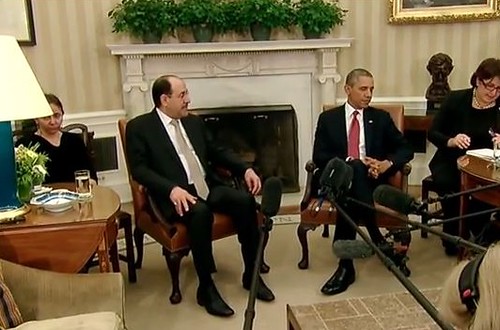
    Remember this?

    bnm.3JPG

    Remember that?

    Maybe this will jog memories.  After the meet-up above took place,  Former US Ambassador Marc Ginsberg pointed out at The Huffington Post:


    By most accounts Iraq is heading toward an unchecked meltdown, and Maliki would like us to believe he deserves a red carpet welcome as the innocent plaintiff in the upheavals he created, not as the felonious defendant he should be adjudged.
    And to top off his disastrous management of Iraq, he wants Washington to legitimate his charade by endorsing his bid for re-election in Iraq's crucial 2014 elections.


    Ginsberg served in the Carter administration and the Clinton administration.  Grasp that when Barack had his last face-to-face with Nouri al-Maliki, November 1, 2013, seven months ago, Nouri's actions were well known.  Ahead of that meet-up, Human Rights Watch issued a press release which noted:

    Iraq’s crackdown on peaceful government critics and an epidemic of executions should be top agenda items during the prime minister’s state visit to Washington, Human Rights Watch said today in a letter to President Barack Obama. Prime Minister Nuri al-Maliki is scheduled to meet with Obama on November 1, 2013.
    Iraqi officials say that Maliki’s priority will be to accelerate US provision of arms, intelligence, and other counterterrorism support, including the immediate delivery of drones and F-16 fighter jets. But Obama should make clear that his administration will prohibit security aid, especially arms, equipment, and training for security forces, unless the Iraqi government ends its widespread use of torture.
    “Iraq is plagued by terrorist attacks that are killing civilians in record numbers, but relying on torture and executions after unfair trials only makes the situation worse,” said Joe Stork, deputy Middle East director. “Obama needs to send a clear message to Maliki that the US will not support his assault on human rights.”

    There was all of that and so much more going on.

    And yet Barack met with Nouri and made nice.

    Let's note some of what Barack said after the meeting:

    And we appreciate Prime Minister Maliki’s commitment to honoring that sacrifice by ensuring a strong, prosperous, inclusive and democratic Iraq.
    [. . .]
    I emphasized the ambition of continuing counterterrorism support and partnership, that we were encouraged by the work that Prime Minister Maliki has done in the past to ensure that all people inside of Iraq -- Sunni, Shia and Kurd -- feel that they have a voice in their government.  And one of the most important expressions of that will be elections next year.  I encouraged that Iraq pass an election law and that that moves forward so that people understand that when they have differences they can express them politically, as opposed to through violence.


    What a bunch of lies.  Nouri was attacking Sunni protesters, Iraqiya had walked out of the government, Nouri was at war with the Kurds and yet Barack lied.

    A strong, prosperous, inclusive and democratic Iraq?

    Yes, it's an obvious lie now.  It was an obvious lie then if you were paying attention.

    Days before the meet-up, US Senators Carl Levin, John McCain, Robert Menendez, Lindsey Graham, Bob Corker and James M. Inhofe released an open letter to President Barack Obama which noted:


    It is essential that you urge Prime Minister Maliki to adopt a strategy to address Iraq’s serious problems of governance. Such a strategy should unite Iraqis of every sect and ethnicity in a reformed constitutional order, based on the rule of law, which can give Iraqis a real stake in their nation’s progress, marginalize Al-Qaeda in Iraq and other violent extremists, and bring lasting peace to the country. To be effective, an Iraqi political strategy should involve sharing greater national power and revenue with Sunni Iraqis, reconciling with Sunni leaders, and ending de-Baathification and other policies of blanket retribution. It should include agreements with the Kurdistan Regional Government to share hydrocarbon revenues and resolve territorial disputes. And it requires a clear commitment that the elections scheduled for next year will happen freely, fairly, and inclusively in all parts of Iraq, and that the necessary preparations will be taken.
    If Prime Minister Maliki were to take actions such as these, he could cement his legacy as the leader who safeguarded his country's sovereignty and laid the foundation for the new Iraq. In this endeavor, Prime Minister Maliki and our other Iraqi partners would have our support, including appropriate security assistance, and we would encourage you to provide U.S. diplomatic support at the highest levels to help Iraqis reach the necessary political agreements before the 2014 elections. However, if Prime Minister Maliki continues to marginalize the Kurds, alienate many Shia, and treat large numbers of Sunnis as terrorists, no amount of security assistance will be able to bring stability and security to Iraq. That is not a legacy we want for Prime Minister Maliki, and that is not an outcome that would serve America’s national interests.


    Nouri met, that week, with members of the US Congress.  On The NewsHour (PBS -- link is video, audio and text), Margaret Warner reported that meet-up did not go well:


    JUDY WOODRUFF: So, Maliki did spend time on the Hill?


    MARGARET WARNER: Mm-hmm.


    JUDY WOODRUFF: And how much progress did he make there? What happened?


    MARGARET WARNER: It went very badly.

    The key meetings yesterday were with Senator McCain and -- excuse me -- Wednesday -- and then with Corker and Menendez. And I'm told that that latter meeting was particularly contentious. They laid out all their concerns. He sort of sat impassively and, according to the aides present, he simply repeated platitudes about how he's governing by the constitution.
    And, finally, Menendez got so -- I don't know if it's angry, but certainly peeved, that he looked at him and he said: Look, I feel you're just glossing over our concerns. And you need to know you're not getting any of this without our OK.
    And Senator Corker came out afterwards and said: We felt he was completely dismissive of our concerns.


    JUDY WOODRUFF: And it's known that one of the things they feel strongly about is he needs to share power.


    Yeah, that was a known.

    And he didn't.

    And look where things stand today.

    It's cute to watch partisan whores try to spin this.  'It's Bully Boy Bush's fault' a lot of stooges insist.

    Fareed Zakaria (Washington Post) agrees Nouri's problematic but wants to distract and deceive:

    But how did Maliki come to be prime minister of Iraq? He was the product of a series of momentous decisions made by the Bush administration. 


    I'm not in the mood for damn liars.

    Nouri got a first term (2006) because Bully Boy Bush insisted on it.

    But he got a second term -- despite losing to Ayad Allawi in the March 2010 elections -- because of Barack.  What the Iraqi Constitution couldn't give Nouri, what the Iraqi people refused to give Nouri, Barack did.  He ordered US officials to negotiate a contract (The Erbil Agreement) to give Nouri a second term.  This contract -- signed by Nouri and the heads of all of Iraq's major political blocs -- found the leaders agreeing to a second term for Nouri in exchange for things they wanted (the Kurds wanted Nouri to implement Article 140 of the Constitution -- which resolves disputed Kirkuk, Iraqiya wanted an independent security council to be headed by Ayad Allawi, etc).

    Fareed, stop lying, stop whoring.

    If you think it was bad for the Iraqi MPs in 2006 to agree to giving Nouri a term as prime minister, it was even worse in 2010 when voters rejected Nouri and Barack spat on the most basic principle in a democracy (voting) to keep Nouri on for a second term.

    November 10, 2010 a power sharing deal resulted in the Parliament meeting for the second time since the March 2010 vote and this was only possible due to The Erbil Agreement.  At that meeting,  Iraqiya felt double crossed on the deal and the bulk of their members stormed out of the Parliament. David Ignatius (Washington Post) explained, "The fragility of the coalition was dramatically obvious Thursday as members of the Iraqiya party, which represents Sunnis, walked out of Parliament, claiming that they were already being double-crossed by Maliki. Iraqi politics is always an exercise in brinkmanship, and the compromises unfortunately remain of the save-your-neck variety, rather than reflecting a deeper accord. "

    How long does Fareed intend to lie and whore?

    In November 2010,  Karen DeYoung (Washington Post) reported:


    Vice President Biden made numerous calls to senior Iraqi leaders over the past several months and U.S. officials directly participated in top-level negotiating sessions that lasted until just moments before the Iraqi parliament finally convened to approve a new power-sharing government Thursday, a senior Obama administration official said Friday.
    Hoping to rebut criticism that it had lost influence in Iraq and was too passive over the eight months since the March election there, or that its efforts were designed to keep Prime Minister Nouri al-Maliki in power, the administration offered a detailed written account of previously unreported meetings, visits and calls it said Biden and others had made.

    The negotiated power-sharing deal DeYoung is writing about is The Erbil Agreement.  Back then, Michael Jansen (Gulf Today) observed, "The deal making that produced last Thursday’s session of parliament is nothing to boast about." She then goes on to note:

    It is not clear why Iraqiya thought Maliki -- a sectarian Shiite whose Dawa party was a bitter enemy of the Baath -- would implement this pledge. Maliki has also failed to carry out solemn promises to recruit into the security forces or find civil service jobs for fighters of the Sunni Awakening Councils -- or Sons of Iraq movement -- who helped US and government forces curb Al Qaeda in 2007-08. Maliki has shown himself to have absolutely no intention of sharing power with Sunnis and certainly not with secular politicians like Allawi who represents the "old Iraq" where politics was non-sectarian.
    In spite of Obama's declaration that an "inclusive" government formula had been found after months of wrangling, Maliki is not interested in including Sunnis, secularists, former Baathists and others who do not subscribe to the ethno-sectarian system imposed on Iraq by the previous Bush administration.

    And Farred wants to whore and lie?

    What Fareed hides, The Erbil Agreement, Barack made a statement about Novemeber 12, 2010:


    Before I discuss the G20, I want to briefly comment on the agreement in Iraq that's taken place on the framework for a new government.  There's still challenges to overcome, but all indications are that the government will be representative, inclusive, and reflect the will of the Iraqi people who cast their ballots in the last election. This agreement marks another milestone in the history of modern Iraq.  Once again, Iraqis are showing their determination to unify Iraq and build its future and that those impulses are far stronger than those who want Iraq to descend into sectarian war and terror. For the last several months, the United States has worked closely with our Iraqi partners to promote a broad-based government -- one whose leaders share a commitment to serving all Iraqis as equal citizens.  Now, Iraq's leaders must finish the job of forming their government so that they can meet the challenges that a diverse coalition will inevitably face.  And going forward, we will support the Iraqi people as they strengthen their democracy, resolve political disputes, resettle those displaced by war, and build ties of commerce and cooperation with the United States, the region and the world.

    And Barack did far more than make a statement that week.  Let's drop back to the November 11, 2010 snapshot to note what happened when The Erbil Agreement wasn't being implemented right away (in fact, it never would be) and Iraqiya walked out of Parliament in protest:


    Martin Chulov (Guardian) reports one hiccup in the process today involved Ayad Allawi who US President Barack Obama phoned asking/pleading that he accept the deal because "his rejection of post would be a vote of no confidence". Ben Lando, Sam Dagher and Margaret Coker (Wall St. Journal) confirm the phone call via two sources and state Allawi will take the post -- newly created -- of chair of the National Council On Higher Policy: "Mr. Obama, in his phone call to Mr. Allawi on Thursday, promised to throw U.S. weight behind the process and guarantee that the council would retain meaningful and legal power, according to the two officials with knowledge of the phone call." 

    But Fareed wants to whore and lie and pretend he can get away with it, that he can rewrite history and tell lies and no one will be the wiser.  Patrick Martin (WSWS) notes it was Bully Boy Bush and Barack both who installed and kept Nouri the prime minister of Iraq:

    Who installed Maliki? His regime was the culmination of the supposed transformation of Iraq into a “democracy.” His election was hailed as a great success, first by George W. Bush, who launched the war, and then by Obama, who completed it on the schedule laid down by his predecessor.


    In 2006, the Parliament wanted to give Ibrahim al-Jafaari a second term as prime minister.  The Bully Boy Bush White House did not trust al-Jafaari for a number of reasons and one of their fears was a second term for anyone so early in Iraq's new 'democracy' stage would risk setting up a new dictator.  They insisted on Nouri and got their way.

    That was bad.

    But in 2010, the voters made clear that they preferred Iraqiya over Nouri's State of Law.  That should have been the end of it.  But Barack ensured that Nouri got a second term he didn't earn.

    Fareed damn well knows that the second term to Nouri was far worse for Iraq than the first term.

    Fareed needs to stop lying and stop whoring.

    And, hopefully, he will.  Too many others have nothing to offer but lying and whoring.  So we'll just ignore them for today.

    The Erbil Agreement is not minor. Ann, in the comments, rightly notes in a comment on James Coogan's WSWS 'analysis' which ignores The Erbil Agreement, "I'm sorry but I don't take seriously any 'analysis' that doesn't point out the 2010 elections were decided by The Erbil Agreement, a legal contract the US pushed to give Nouri a second term."

    David Ignatius (Washington Post via Real Clear Politics) points out:

    Maliki's failure has been increasingly obvious since the elections of 2010, when the Iraqi people in their wisdom elected a broader, less-sectarian coalition. But the Obama administration, bizarrely working in tandem with Iran, brokered a deal that allowed Maliki to continue and has worked with him as an ally against al-Qaeda. Maliki's coalition triumphed in April's elections, but the balloting was boycotted by Sunnis.

    Given Maliki's sectarian and authoritarian style, a growing number of Iraq experts are questioning why the Obama administration continues to provide him billions in military aid -- and is said to be weighing his plea for lethal Predator drones. The skeptics include some who were once among Maliki's champions.
     
    Iraq's on fire today because Nouri didn't honor The Erbil Agreement and instead attacked Sunni politicians and protesters, because he refused to nominate people to head the Ministries of Defense, Interior and National Security in order to steal control of those ministries.  As the head of the Minister of the Interior, he was responsible for sending the MoI employees into schools to demonize Iraqi gays and lesbians, to encourage students to attack and kill those they suspected of being gay, to lie and state that they sucked blood as vampires did, that they deserved to be killed and much more.  Nouri, of course, denied such claims were made.  However, Alsumaria and Al Mada got ahold of handouts MoI employees passed out at their school presentations proving that they were making these smears in an attempt to incite violence against Iraq's gay and lesbian population (and those who might be perceived as such).  Gay men (and men thought to be gay) were killed with bricks, they were killed via torture, they were killed in so many ways and this took place on Nouri's orders.

    So for those dirty, nasty whores -- Katrina vanden Heuvel, step up -- who cover for Nouri today?  You're homophobic trash and you threaten the safety of not just gays and lesbians but of minorities around the world.  You should be ashamed of yourselves and, honestly, shut your mouths and hang your heads in shame.  [If you're interested in some of the people who got it wrong and some of the people who got it right last week, see "The media rediscovers Iraq (Ava and C.I.)."]


    RECOMMENDED: "Iraq snapshot"
    "Isaiah's The World Today Just Nuts "He Wins Again!..."
    "June 2014, deadliest month in Iraq since July 2007..."
    "CNN's selective outrage"
    "Levin statement on the situation in Iraq"
    "American Legion to conduct town hall meeting and c..."
    "Court Dismisses ACLU Suit on Behalf of U.S. Citize..."
    "Hejira"
    "Stop $ for Ukraine murders (Workers World)"
    "Maya Angelou 1928-2014"
    "Rebels seize tanks and armored vehicles"
    "I Hate The War"
    "Readout of Secretary Kerry's Call With Iraqi Forei..."
    "An uprising by millions of Iraqis or an attack by ..."
    "Political Systems in the Arab World in 2020: Movi..."
    "Barack The Strike Breaker"
    "Lois Lerner and her missing e-mails"
    "salem: arresting a witch"
    "Where are troops going?"
    "Thug Nouri loses another city"
    "Casey Kasem"
    "Movies and Powerpuff Girls"
    "Iraq"
    "Beyonce and other things"
    "Back to Iraq?"

    "He loves himself the most"
    "THIS JUST IN! HIS VANITY IS APPALLING!"

    Saturday, June 14, 2014

    He loves himself the most

    BULLY BOY PRESS &     CEDRIC'S BIG MIX -- THE KOOL-AID TABLE

    LIKE WOODROW WILSON IN 1919, FADED CELEBRITY BARRY O WENT TO SPEAK TO THE SIOUX.

    LIKE BARRY O ALWAYS DOES, HE MADE IT ALL ABOUT HIM INSISTING TO THE NATIVE AMERICAN CHILDREN THAT HE TOO GREW UP BELIEVING HE WAS "ON THE OUTSIDE LOOKING IN."

    REACHED FOR COMMENT, BARRY O ASKED, "WELL ISN'T IT ALL ABOUT ME?  I'M THE CENTER OF THE UNIVERSE, YOU KNOW."


    FROM THE TCI WIRE:


    On the White House;s South Lawn this afternoon, en route to boarding a helicopter, US President Barack Obama stopped to make a few comments on Iraq:


    Yesterday, I convened a meeting with my National Security Council to discuss the situation there, and this morning I received an update from my team.  Over the last several days, we’ve seen significant gains made by ISIL, a terrorist organization that operates in both Iraq and in Syria.  In the face of a terrorist offensive, Iraqi security forces have proven unable to defend a number of cities, which has allowed the terrorists to overrun a part of Iraq’s territory.  And this poses a danger to Iraq and its people.  And given the nature of these terrorists, it could pose a threat eventually to American interests as well.

    Now, this threat is not brand new.  Over the last year, we’ve been steadily ramping up our security assistance to the Iraqi government with increased training, equipping and intelligence.  Now, Iraq needs additional support to break the momentum of extremist groups and bolster the capabilities of Iraqi security forces.  We will not be sending U.S. troops back into combat in Iraq, but I have asked my national security team to prepare a range of other options that could help support Iraqi security forces, and I’ll be reviewing those options in the days ahead.
    I do want to be clear though, this is not solely or even primarily a military challenge.  Over the past decade, American troops have made extraordinary sacrifices to give Iraqis an opportunity to claim their own future.  Unfortunately, Iraq’s leaders have been unable to overcome too often the mistrust and sectarian differences that have long been simmering there, and that’s created vulnerabilities within the Iraqi government as well as their security forces.
    So any action that we may take to provide assistance to Iraqi security forces has to be joined by a serious and sincere effort by Iraq’s leaders to set aside sectarian differences, to promote stability, and account for the legitimate interests of all of Iraq’s communities, and to continue to build the capacity of an effective security force.  We can’t do it for them.  And in the absence of this type of political effort, short-term military action, including any assistance we might provide, won’t succeed. 
    So this should be a wake-up call.  Iraq’s leaders have to demonstrate a willingness to make hard decisions and compromises on behalf of the Iraqi people in order to bring the country together.  In that effort, they will have the support of the United States and our friends and our allies. 
    Now, Iraq’s neighbors also have some responsibilities to support this process.  Nobody has an interest in seeing terrorists gain a foothold inside of Iraq, and nobody is going to benefit from seeing Iraq descend into chaos.  So the United States will do our part, but understand that ultimately it’s up to the Iraqis, as a sovereign nation, to solve their problems.
    Indeed, across the region we have redoubled our efforts to help build more capable counterterrorism forces so that groups like ISIL can’t establish a safe haven.  And we’ll continue that effort through our support of the moderate opposition in Syria, our support for Iraq and its security forces, and our partnership with other countries across the region. 
    We’re also going to pursue intensive diplomacy throughout this period both inside of Iraq and across the region, because there’s never going to be stability in Iraq or the broader region unless there are political outcomes that allow people to resolve their differences peacefully without resorting to war or relying on the United States military. 

    We’ll be monitoring the situation in Iraq very carefully over the next several days.  Our top priority will remain being vigilant against any threats to our personnel serving overseas.  We will consult closely with Congress as we make determinations about appropriate action, and we’ll continue to keep the American people fully informed as we make decisions about the way forward. 


    He took a few questions and we'll note this response: "And obviously, our troops and the American people and the American taxpayers made huge investments and sacrifices in order to give Iraqis the opportunity to chart a better course, a better destiny.  But ultimately, they're going to have to seize it.  As I said before, we are not going to be able to do it for them.  And given the very difficult history that we’ve seen in Iraq, I think that any objective observer would recognize that in the absence of accommodation among the various factions inside of Iraq, various military actions by the United States, by any outside nation, are not going to solve those problems over the long term and not going to deliver the kind of stability that we need."


    AFP's WG Dunlop offered this observation on Barack's comments.


    Immediately after Barack's remarks were aired live, Andrea Mitchell Reports (MSNBC -- link is video) went to a pre-recorded interview with Senator John McCain.

    Senator John McCain:  Well our Director of National Intelligence, General [James] Clapper, has already said what is happening in this area of Syria - Iraq has now been dramatically expanded and also has enriched does post a threat for attacks to be planned on the United States of America.  That is the opinion of our Director of National Intelligence.  And I share it.

    Andrea Mitchell:  What should the president do?  He says he's only ruled out ground troops.  So he is considering military options.  We're expecting decisions. What would you advise him to do?

    Senator John McCain: Andrea, I think that -- I think the national security team should be replaced. But that's not going to happen.  So then, he should bring in other individuals such as General [Jack] Keane, the architect of the surge which succeeded and we had it won, people like the Kagans at  the Institute for the Study of War  [Kimberly Kagan and Fred Kagan], other -- and Ambassador Ryan Crocker.  I think I would put [former top US commander in Iraq] David Petraeus on a plane to Baghdad right now and try to sort all this out.  And, also, Maliki has got to be more inclusive.  He's got to completely change, the way he's treated the Sunni and it may be too late, I don't know.  Maybe it needs to be somebody else?   But now we need to move forward. We've got to plan not only on the military side of it but on the political side of it as well because it's clear that the Sunnis have been alienated completely by Maliki and the way he's handled his leadership in Iraq. 


    A few things on the above.

    James Clapper?  Could Clapper be right?

    Clapper lied to Congress.  The matter should have immediately been turned over to the Justice Dept and Barack should have asked for a resignation.

    That didn't happen.

    So Clapper has no standing now.  McCain can cite him all he wants but Clapper is a known liar who went before the Congress and lied.  When an official does that, they need to resign.

    Clapper could be 100% right that this group of people -- whatever you term them -- are or will plan attacks on the US.  But he's a liar who's disgraced his name and few are going to rush to believe him.

    McCain may have seen information -- I'm sure he has -- independently that makes him believe Clapper's assertion.

    I don't believe the assertion.  There's no support being presented to the public for it.

    There's also no common sense argument for it.

    This group allegedly wants to take over not just Iraq but Syria as well.  They're also going to expand to attacks on the US?

    No.

    Should they take over Iraq, if they also want to take over Syria, that would be their goal.

    And if they achieved that?  They'd go for the region.

    I don't see where they -- as Clapper believes -- would be making one advance after another in the region and suddenly decide to focus on the US.

    It doesn't make sense.

    Doing so would slow their attempted march to take over the region.

    Doing so would also unleash a response (and hatred and anger) aimed at them from the US and it would mean a full out war.

    So I don't see how they'd want to court that anger and the combat response that would follow.

    They might.

    But thus far, we have allegations only and we have common sense.  And common sense does not back up the allegations.

    That McCain would suggest a group that includes the neocon Kagan family (which also includes Barack advisor Robert Kagan and his wife Victoria Nuland who's with the State Dept) isn't surprising (he is right-wing).  But due to other comments by McCain in the past, we should note that he made clear he was not calling for US troops back into Iraq. ("I do not envision a scenario where ground troops are on the ground [. . .] I would not commit to putting American boots on the ground in order to achieve that in deference to that weariness that you so accurately describe.")


    RECOMMENDED: "Iraq snapshot"
    "Save Nouri or save the Iraqi people?"
    ""A Statistically Tested Way to Stop Terrorism and ..."
    "STATEMENT BY SENATORS McCAIN AND GRAHAM ON DEVELOP..."
    "European Politicians Form A New NGO to Improve Pol..."
    "White Beans, Spinach and Tomatoes over Linguine in the Kitchen"
    "22 Jump Street"
    "Idiot of the week"
    "And that's why I ignore Hillary Is 44"
    "22 Jump Street"
    "iraq"
    "The problem that is Nouri al-Maliki"
    "Cass Elliot made her own kind of music"
    "A pig named Lambert"
    "50 'facts' on women who rock?"
    "All hail the new loser!"
    "THIS JUST IN! CALL HIM BARRY BUSH!"


    Friday, June 13, 2014

    All hail the new loser!


    BULLY BOY PRESS &     CEDRIC'S BIG MIX -- THE KOOL-AID TABLE

    FOR YEARS NOW, BULLY BOY BUSH HAS BEEN THE MOST UNPOPULAR LIVING OCCUPANT OF THE OVAL OFFICE.

    TODAY, THAT ALL CHANGES!

    FADED CELEBRITY BARRY O IS NOW AS UNPOPULAR AS BULLY BOY BUSH.

    THE AMERICAN PEOPLE HAVE SPOKEN, THERE'S A NEW LOSER IN TOWN.


    FROM THE TCI WIRE:


    This morning, Juan Gonzalez (Democracy Now! -- link is audio, video and text) declared, "Iraq is on the brink of disintegration. Sunni Islamist rebels have seized control of Mosul, Iraq’s second-largest city, as well as Tikrit, Saddam Hussein’s hometown, and Dhuluiya which is just 55 miles northwest of the capital of Baghdad. The rebels are now advancing toward Baghdad. Meanwhile, Iraqi Kurds have seized control of the northern oil city of Kirkuk. The Sunni militants are led by a group called ISIS, the Islamic State in Iraq and Syria. They now control a territory that stretches from the eastern edge of Aleppo, Syria, to Fallujah in western Iraq and now the northern city of Mosul. The sudden advance by the Islamist rebels has shocked the region. Earlier today, Russian Foreign Minister Sergey Lavrov said the territorial integrity of Iraq is now in question."


    This afternoon at the White House, US President Barack Obama declared, "We discussed the situation in the Middle East, and obviously the concerns that we have around Iraq and Syria.  Both our countries are potentially threatened by jihadists and freedom fighters, as they call them, that are going into Syria, getting trained in terrorist tactics and then potentially coming back to our countries and could end up being a significant threat to our homeland, as well."

    "We" was a reference to himself and Abbot, Prime Minister of Australia.  The two met today to discuss various issues.  After the discussion, the two addressed the press.  We'll note this exchange between Barack and the Associated Press' Nedra Pickler:


    Q    Mr. President, are you considering drone strikes or any sort of action to stop the insurgence in Iraq?


    PRESIDENT OBAMA:  Well, this is an area that we’ve been watching with a lot of concern not just over the last couple of days but over the last several months, and we’ve been in close consultation with the Iraqi government.  Over the last year, we have been providing them additional assistance to try to address the problems that they have in Anbar, in the northwestern portions of the country, as well as the Iraqi and Syrian border.  That includes, in some cases, military equipment.  It includes intelligence assistance.  It includes a whole host of issues.
    But what we’ve seen over the last couple of days indicates the degree to which Iraq is going to need more help.  It’s going to need more help from us, and it’s going to need more help from the international community. 
    So my team is working around the clock to identify how we can provide the most effective assistance to them.  I don’t rule out anything, because we do have a stake in making sure that these jihadists are not getting a permanent foothold in either Iraq or Syria, for that matter. 
    Part of the challenge -- and I’ve said this directly to Prime Minister Maliki, and Vice President Biden has said this in his very frequent interactions with the Iraqi government -- is that the politics of Shia and Sunni inside of Iraq, as well as the Kurds, is either going to be a help in dealing with this jihadist situation, or it’s going to be a hindrance.  And frankly, over the last several years, we have not seen the kind of trust and cooperation develop between moderate Sunni and Shia leaders inside of Iraq, and that accounts in part for some of the weakness of the state, and that then carries over into their military capacity.
    So I think it’s fair to say that in our consultations with the Iraqis there will be some short-term, immediate things that need to be done militarily, and our national security team is looking at all the options.  But this should be also a wakeup call for the Iraqi government.  There has to be a political component to this so that Sunni and Shia who care about building a functioning state that can bring about security and prosperity to all people inside of Iraq come together and work diligently against these extremists.  And that is going to require concessions on the part of both Shia and Sunni that we haven’t seen so far. 
    The last point I’ll make -- what’s happened over the last couple of days I think underscores the importance of the point that I made at my West Point speech:  the need for us to have a more robust regional approach to partnering and training partner countries throughout the Middle East and North Africa.  We’re not going to be able to be everywhere all the time, but what we can do is to make sure that we are consistently helping to finance, train, advise military forces with partner countries, including Iraq, that have the capacity to maintain their own security.  And that is a long and laborious process, but it’s one that we need to get started. 

    That’s part of what the Counterterrorism Partnership Fund that I am going to be calling for Congress to help finance is all about, giving us the capacity to extend our reach without sending U.S. troops to play Whac-A-Mole wherever there ends up being a problem in a particular country.  That’s going to be more effective.  It’s going to be more legitimate in the eyes of people in the region, as well as the international community.  But it’s going to take time for us to build it.  In the short term, we have to deal with what clearly is an emergency situation in Iraq.


    Those remarks came up in today's State Dept press briefing moderated by spokesperson Jen Psaki:


    QUESTION: -- you just announced this aid for internally displaced people. Have any decisions been made about – or can you enlighten us on where the process is on what the President outlined with the Australian foreign minister in terms of the options being considered for assisting the Iraqi Government in dealing with the deteriorating situation?


    MS. PSAKI: Mm-hmm. Well, what you have seen – and I know you saw it, Matt, but just for the benefit of others, the President did speak to this just a little while ago, in the last hour. And what he said and made clear is that we’ve had a lot of concern, not just in the last couple of days but months. And what we’ve seen over the last couple of days is an indication that Iraq needs more help.
    Our team is working overtime on a range of options that does not include, to be clear, boots on the ground. Secretary Kerry is clearly very engaged in these discussions, which are ongoing. And Deputy Assistant Secretary Brett McGurk, of course, is as well, given he’s on the ground, as well as a range of officials from the State Department. I don’t have anything to enlighten you on, given these are ongoing discussions. But the President made clear that in the short term there may be the immediate need for additional military assistance, and there’s an ongoing discussion about that.

    QUESTION: So immediate means possibly by the end of the day or in the next --

    MS. PSAKI: I’m not giving a timing indication. I think what he’s indicating is in the short term, in addition to the capacity building that we’re doing over the medium and long term.

    QUESTION: Right. Do you have any thoughts about the Iranians saying that they’re willing to help defend the Shia community or defend Baghdad and/or, both, the Kurds taking control of Kirkuk? Do these developments cause you any concern?


    MS. PSAKI: Well, let me take the second one first. We support the steps taken between the federal government and the Kurdish regional government to cooperate on a security plan that will enhance the Iraqi army’s ability to hold positions and confront ISIL. We’re encouraging both Baghdad and Erbil to continue and further their cooperation, given the immediate threat that they’re all facing from ISIL on the ground.


    So at this point, the official position is "no boots on the ground."

    Barack is President.  Joe Biden is Vice President.  Let's note this:


     Biden noted the "internal threat" aspect being proposed and how these requires the US "to support the Iraqi government in its battle with all 'outlaw groups' -- that's a pretty expansive commitment."  He noted that it requires the US "to take sides in Iraq's civil war" and that "there is no Iraqi government that we know of that will be in place a year from now -- half the government has walked out." 
     "Just understand my frustration," Biden explained.  "We want to normalize a government that really doesn't exist." 


    No, Joe didn't just Sally Langston Barack (reference to Shonda Rhimes' Scandal).

    That's Joe speaking when he was Senator Joe Biden and chair of the Senate Foreign Relations Committee.  We covered the hearing in the April 10, 2008 snapshot -- it remains one of the most important hearings the Committee held on Iraq.  We were among the few to turn out for it.  The week had seen then-General David Petraeus and then-US Ambassador Ryan Crocker testify to several Congressional committees.  By the time Friday rolled around, the press may have been exhausted.

    Too bad.  It was an important hearing.

    When Joe spoke those words, the prime minister of Iraq was Nouri al-Maliki.

    He's still prime minister right now, finishing his second term.

    What's really changed is that as bad as Nouri's first term was -- and it was bad -- his second has been even worse.  And he's created more chaos and violence.

    Joe's concerns in 2008 were valid.

    They're only more valid today.

    The White House needs to walk away from Nouri and not just because it's important to Iraq but also because it's important to the presidency.  We'll get to the second point later in the snapshot.

    For now, back to Democracy Now!'s discussion on Iraq:


    MOHAMMED AL DULAIMY: What I see is the failing of the whole system that the United States and its allies, they tried to build in Iraq. The whole democracy experiment in Iraq is in danger, as actually has been for a long time in danger, but now it’s more obvious to everyone. We are seeing now the consequences of a leadership of a sectarian regime that was ruling in Iraq for the past eight years, led by Mr. Nouri al-Maliki, and the lack of trust among his partners, corruption. All of that gave the way for radicals to rise and gave the chance to occupy a two million city, population city, in Mosul, the second-largest Iraqi city. All of this is threatening the integrity of Iraq, the unity of the country, and threatening Iraq to descend to a more like Syrian-like civil war.

    JUAN GONZÁLEZ: And when you talk about the reign of al-Maliki and the sectarianism of his government, could you elaborate on that? Because clearly al-Maliki as a Shiite leader and the majority of the population of Iraq being Shiite, the United States has continued to back his rule there despite his clampdown on any kind of dissent.

    MOHAMMED AL DULAIMY: Yes, we have enough evidence, actually, videos of speeches of Mr. al-Maliki himself, showing that this man is leading the country towards a civil war. His previous press conferences accusing his partners of terrorism, sometimes forging cases against them, as they say, led the country to high tension, causing Sunnis to go into streets to protest and to show their demands. Mr. al-Maliki refused most of these demands. And to the limit, he accused them of continuing some historical event that took place 1,400 years ago, about 1,400 years ago, and he said that the killers of Imam Husayn are still living among—he meant Sunnis—among the other party, which he meant Sunnis. Mr. al-Maliki has failed to build an Iraqi military that will respect human rights. I just want to say that fanatics, Islamists, feed on such human rights breaches. It helps them to further their cause and to win more recruits. This is what has had—happening in Iraq.
    And you can see the videos of how the Iraqi army dealt with demonstrators in Hawija, how they killed men carrying sticks, only iron sticks, or sometimes carrying nothing. You could see the video, the brutality of the military. Mr. al-Maliki punished no one. Mr. al-Maliki always refuses to address these issues to de-escalate the sectarian tensions in Iraq. Mr. al-Maliki always also refused to disarm some Iranian-backed trained Shia militias like al-Asa’ib. These kinds of actions caused the Sunni community to live in a turmoil. And here I think that the United States, the administration, we, all of us, should speak loudly to stop the descent of the country into that civil war, to stop pushing ordinary people towards fanatics to join their lines just to defend themselves against an army that is willing to kill them all.


    Mohammed Al Dulaimy is a name many should already know.  If you don't, think Sahar Issa or Laith Hammoudi.  They were among the Iraqi reporters working for McClatchy Newspapers.  They went out of their way and took great risks to let the world know what was really happening in Iraq.  Today, Al Dulaimy is seeking refugee status in the United States -- status which should be immediately granted.  He's the perfect example of why the program was created.


    RECOMMENDED: "Iraq snapshot"
    "It was never about oil . . . right?"
    "Senate Passes Legislation to Fix the Department of..."
    "Legion thanks Congress for swift response"
    "Moving Forward After VA Loses Top Leader"
    "VETERANS: Murray Remarks on Sanders-McCain Comprom..."
    "Talk Nation Radio: Daniel Hyslop on How Militarism..."
    "The Legacy of World War II (Elliott Adams)"
    "The Ego Tripper's Workout"
    "The Detroit model repeats "
    "Tom Hanks is a tool"
    "1 activist dies, another sees his reputation die"
    "If she told the truth, f**k her"
    "TV"
    "Dandelions"
    "James Risen"
    "Remembering Ruby Dee"
    "We're going to have to suffer through Hillary's babble?"
    "The polls! The polls!"
    "THIS JUST IN! MORE BAD NEWS FOR BARRY!"


  • Thursday, June 12, 2014

    The polls! The polls!

    BULLY BOY PRESS &     CEDRIC'S BIG MIX -- THE KOOL-AID TABLE

    52% OF AMERICANS SEE FADED CELEBRITY BARRY O UNFAVORABLY IN THE LATEST POLL.

    REACHED FOR COMMENT THIS MORNING BY THESE REPORTERS, BARRY O SIGHED, "52%?  THAT'S BAD.  BUT AT LEAST MOST AMERICANS STILL LIKE ME, RIGHT?"

    TOLD HE WAS ALSO POLLING POORLY ON THE PRISONER SWAP, BARRY O HUFFED, "I SUPPOSED I COULD HAVE STAYED HOME AND SWAPPED RECIPES AND HAD TEAS, BUT WHAT I DECIDED TO DO WAS FULFILL MY PROFESSION."

    FROM THE TCI WIRE:


    At The Huffington Post, Daniel Nisman offers an analysis which includes:

    In a troubling development, Maliki has already threatened to "arm citizens" to fight ISIS, and claimed to have created a special crisis unit to implement a process of "volunteering and equipping." Such rhetoric is eerily in line with Maliki's past tendencies of mobilizing Shiite militias, many of them religious extremists, to combat Sunni jihadists. In the recent Fallujah and Ramadi counteroffensives, local residents complained of seeing Shiite militia insignias on Iraqi army tanks, alleging that these militias had been mobilized under the guise of the regular army, accusations that only fomented further mistrust among the Sunni population.

    I agree with many of the points Nisman makes elsewhere in his analysis.  Read the whole thing. At the Wall St. Journal, Kenneth M. Pollack offers mini-analysis and suggestions.  I disagree with so much.  Pollack seems unaware that he's arguing the Iraq War was about oil (but when you write, that the events in Iraq right now are "a serious threat for the United States.  Americans seem to think that the vast increased in domestic oil production from shale deposits has immunized the U.S. economy from Middle East instaiblity" that's what you're suggesting).

    We're going to look at these two suggestions Pollack makes in order to clarify why I disagree with him:

    • A constitutional amendment imposing a two-term limit on the presidency and prime ministership. (A third term for Mr. Maliki may have to be grandfathered in to get him to agree, but simply advertising to all Iraqis that he will not rule for life would be an important reassurance that Iraq is not drifting back into dictatorship.)

    Really?

    Nouri is the cause of the violence.  Pollack doesn't state that, I do.  He does note Nouri abuses power.  So even though Moqtada al-Sadr, the Kurds, Osama al-Nujaifi, Ayad Allawi and various others opposed a third term for Nouri (that list includes Ammar al-Hakim provided al-Hakim is named prime minister), the Iraqi people have to endure Nouri?


    That makes no sense.

    Nor does the notion that Nouri accepts the imposing of two terms only.

    Here's what will most likely happen.  Nouri might agree to get his third term.  He would then say the law passed after he started his third term so he can still be elected to two more terms.

    I'm sorry Pollack didn't pay attention the what happened in the KRG recently.  KRG President Massoud Barzani was in office when the KRG's Parliament passed the two term rule for his post.  What happened?

    He was allowed two terms plus two years because it was passed two years after his first term started.

    And Nouri's State of Law had a reaction.  I get so damn tired of spoon feeding.  But they had a reaction and it was publicly stated to Iraqi media that if a two-term law ever passed for the Iraqi prime minister post (I believe it did pass and then Nouri's court ruled it unconstitutional, but whatever), that term limit would only kick in for elections after the law passed.

    Which would mean Nouri could go five term.

    Again, people need to pay attention.

    I'm being more kind than I usually am on stuff like this because I believe Pollack genuinely thought his suggestions had value.  Let's examine another:


    • A law defining the powers and prerogatives of the defense and interior ministers, thereby limiting the ability of the prime minister to exercise those powers.


    What?

    Does Pollack not know that Nouri grabbed those powers?

    He did so by refusing to nominate anyone for the security posts.


    Back in July 2012, Mohammed Tawfeeq (CNN) observed, "Shiite Prime Minister Nuri al-Maliki has struggled to forge a lasting power-sharing agreement and has yet to fill key Cabinet positions, including the ministers of defense, interior and national security, while his backers have also shown signs of wobbling support."

    Nouri's second term is ending and those three Cabinent posts remain empty.

    Nouri controls them.

    Now, Pollack, help me out on how Nouri's going to be forced to nominate people for those posts this go round having made it through four years without them?

    The easiest way to slow down the violence is to kick Nouri out of office.  The US government needs to pull all support.  If you don't grasp that, maybe you shouldn't be having this conversation.

    Iraqis are scared of Nouri because he's a thug and he's destroyed the country and Pollack wants to suggest the answer is a third term?

    Violence didn't disappear after the April 30th elections.  But it did kick up a notch after Nouri claimed (he was lying) that he had the seats in Parliament to get a third term.

    That's when the already violent day-to-day got more violent.

    You are stripping a people of hope and forcing them to live in fear.  Of course, they will resort to violence.

    Pollack is correct when he notes that "the Obama administration seems to turn a blind eye toward Iraq no matter how bad things get."  And they continue to support Nouri.

    Nouri breaks every promise.  He breaks with them with the Iraqi people.  He broke them with Bully Boy Bush.  He's broken them with Barack Obama.

    You have to want to be fooled to take Nouri at his word today.

    He promised to implement the White House's benchmarks.  Bully Boy Bush came up with those.  They never got implemented.  Barack's on his second term and Nouri never kept his word on the benchmarks.  To get his second term as prime minister, Barack had US officials negotiate The Erbil Agreement -- quid pro quo, Nouri promised leaders of political blocs certain things in writing in exchange for their agreeing to grant him a second term.  He briefly honored the contract -- long enough to start his second term.  Then he refused to honor it.  This led to the political crisis which led to the increased violence.

    Nouri lies and you have to be an idiot at this late date to think that the man who twice took an oath to the Iraqi Constitution but has twice failed to implement Article 140 as the Constitution compels him to (it resolves the disputed Kirkuk) is going to honor any promise.

    He's a liar. And only the extreme idiots would, at this late date, believe him when he promised he was going to do something.


    RECOMMENDED: "Iraq snapshot"
    "Mosul's fall was inevitable"
    "House Passes Two More Bills in Two Days on Access ..."
    "American Legion to host TBI/PTSD symposium in Wash..."
    "IAVA CEO and Founder Meets With Senator Richard Bu..."
    "Is President Poroshenko Taking Orders from the CIA..."
    "Nadja Tesich (Sara Flounders)"
    "WSWS advances White House line"
    "Netflix"
    "Betrayal (unless you're a Cuomo groupie)"
    "glenn"
    "Barack's the new Warren G. Harding"
    "The ongoing VA scandal"
    "Save the internet"
    "Turn the Clapper matter over to the Justice Department"
    "Barack's war on journalism"
    "Some rare good news"
    "Applause addiction can prove costly"
    "THIS JUST IN! HE MISSES THE CROWDS!"