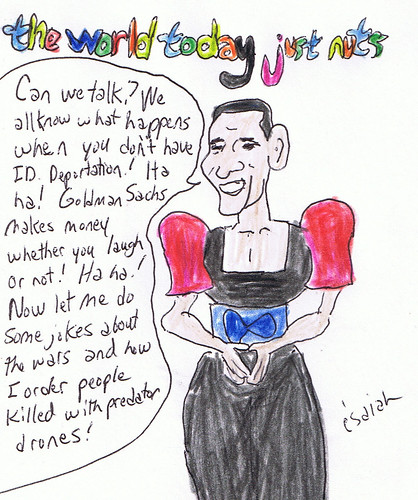
BULLY BOY PRESS & CEDRIC'S BIG MIX -- THE KOOL AID TABLE
GALLUP FINDS THAT 2 IN 3 REGISTERED VOTERS DISAPPROVE OF BARRY O'S HANDLING OF THE IMMIGRATION ISSUE.
THE FADED CELEBRITY IN CHIEF IS GETTING ONE FAILING REPORT CARD AFTER ANOTHER.
"AT THIS RATE," BARRY O FRETTED TO THESE REPORTERS, "I'LL GET PULLED OFF THE VOLLEYBALL TEAM! THIS COULD COMPLETELY DESTROY MY EXTRA CURRICULAR ACTIVITIES!"
FROM THE TCI WIRE:
How bad is it? Longtime Nouri enabler and minimizer
Patrick Cockburn (Indpendent) writes today, "Isolated and discredited by humiliating military
defeat, the Iraqi Prime Minister, Nouri al-Maliki, is likely to go
soon, battered as he is by only slightly veiled demands for his
immediate departure from powerful figures who once supported him."
Dave Zweifel (Madison Cap Times) offers, "If al-Maliki can't reach -- or more likely, refuses to reach -- an
agreement with other factions to share in Iraq's government, then we
need to walk away."
Why is he right? Dave Zweifel is right. You can argue he's right
because Nouri has committed War Crimes, had journalists arrested and
beaten,
beaten and killed protesters and bred violence and division in the
country.
I would certainly agree with all those reasons.
But there's another reason and it's one the press hasn't paid attention to.
Dropping back to
yesterday's snapshot:
Wednesday night on The NewsHour (PBS -- link is text, audio and video), Judy Woodruff moderated a discussion between Senator Tim Kaine and Senator John McCain. We'll note this:
JUDY WOODRUFF: Should the U.S. be providing military — more military assistance to Iraq right now?
SEN. TIM KAINE:
Judy, the question is a little bit premature, because what we really
need — and there is a process — the way this is supposed to work is the
president will come to us and lay out what he thinks is the preferred
option.
And then, after consulting with Congress, we will go
forward. I expect that he will do that soon. He’s already been in
significant consultation, not only with leadership, but with others like
me, but when he does come, there’s going to be some hard questions.
Maliki
— we had the opportunity. The U.S. wanted the stay in Iraq and Maliki
basically kicked us out. He didn’t want us to stay. Then he ignored all
the advice that we and others gave him about how to govern Iraq, to try
to do it in a way that brought Kurds and Sunnis and Shias together.
Instead, he’s run Iraq for Shias and marginalized, even oppressing Sunni
and Kurds.
And so this extremism, the Sunni extremism, has been a
predictable consequence of that, in my view. They’re horrible people
doing horrible things, but he’s given them an opening by governing in
such an autocratic way.
So, if it’s just a matter of, do we come
in now to back up Maliki with military force after he kicked us out and
after he’s governed the wrong way, that would be foolish. What we should
be first talking about is, are there reforms that the Iraqis are
willing to make to try to demonstrate to all in the country that they
are all going to be treated equally?
Those kind of reforms really are the things that have to happen before we decide what kind of assistance we should provide.
JUDY WOODRUFF: Well, you have had raised a couple of things. And let me just pick them one by one.
In
terms of the reforms, Prime Minister Maliki says he has reached out,
for example, to Sunnis. He’s brought them — he’s given them a role in
his government. He says, in essence, that it’s just wrong to say that he
has not reached out.
SEN. TIM KAINE: Virtually every
objective account that we have heard from Iraq experts here, not only
folks connected with the administration, State Department, DOD, but NGOs
and others, suggest just the contrary, that he has ignored that advice
and that he has run this government for Shias with the strong support of
the Shia-based government in Iran, and he has done it in a way that has
marginalized Sunnis and marginalized Kurds.
And that’s why they’re not coming to his aid right now.
We'll note McCain now publicly favors "boots on the ground" but we're
not interested in his comments. Not because he's a Republican but
because Kaine came close to something, circled around it -- like Cher
with a note she never quite hits -- but never got to it. We'll cover it
in Friday's snapshot. We are by no means done with this topic.
We keep hearing various voices saying 'Maliki kicked us out.'
There's actually much worse than no SOFA, there's wasted billions. Yes,
some of it was supposedly brought back in, some of the US taxpayer
millions were not wasted, supposedly.
I mean "supposedly" because it's the State Dept which operated without
any oversight during Barack's first term -- something that reporters
should be hitting Hillary Clinton on hard. John Kerry wasn't Secretary
of State for more than nine months when he made good on his promise to
have an IG for the State Dept -- a position that was empty for Hillary's
entire four years as Secretary of State.
It matters and reporters should be asking her why she felt she was above oversight.
Because she felt that way, the country still doesn't know what was done
with all the money, there are several ongoing investigations trying to
determine whether the State Dept lost money, had it stolen or what.
But, at it's most basic, Barack's plan for Iraq is to provide assistance and training.
Let's speak very slowly because some people don't get other governments.
In the United States, Barack Obama is president. He nominates people to
be in the Cabinet. For example, he nominated Chuck Hagel to be
Secretary of Defense. The Senate confirmed that nomination, voted for
Hagel. Hagel is now Secretary of State. If Barack is unhappy with
Hagel's performance, he will ask for Hagel's resignation. By custom --
though not by law -- Hagel would then resign.
It's different in Iraq. The president is not the head of their country
and not elected in a general election. The head of their country is the
prime minister -- also not elected in a general election. Parliament
elects a prime minister-designate. The prime minister -- if he or she
abides by the Constitution -- has 30 days to name a Cabinet -- that's a
full Cabinet. It's the only rule for moving from prime
minister-designate to prime minister. In 2010, Nouri got a second term
via the extra-constitutional and US-brokered Erbil Agreement so he
didn't have to abide by the Constitution.
He refused to nominate people to head the three security ministries.
That includes the Ministry of the Interior which is over the federal
police. Let's say Nouri had wanted Chuck Hagel for that spot and Hagel
had wanted that spot and taken Iraqi citizenship. If Nouri had
nominated him and Parliament had approved him, Chuck Hagel would be
Minister of the Interior. If Nouri decided he didn't want Chuck after
the vote, Nouri had no say.
Hagel could stay on. Hagel is not required to step down. The only one
who can remove Hagel from office is the Parliament. So if Nouri
nominates someone and the Parliament votes them into that office, they
basically own that office for the full term.
Nouri staged a power grab -- unconstitutional and no one wanted to call it out and very few even wanted to mention it.
One exception would be CNN's Mohammed Tawfeeq. Another would be
Nussaibah Younis whose October 2012 "Time to Get Tough on Iraq" (New York Times) offered a number of important observations including:
Even
apart from the Syrian crisis, the United States should be getting tough
on the Maliki regime to prevent Iraq's descent into authoritarianism.
Although Prime Minister Maliki's first term had its successes, including
the "Charge of the Knights" attack against Shiite militias in Basra in
2008, Prime Minister Maliki has become increasingly consumed by his own
dictatorial ambitions. And a number of his actions have heightened
sectarian tensions in Iraq. He cut a deal with the extremist Shiite
party led by Moktada al-Sadr. He reneged on a promise to meaningfully
include the Sunni-dominated Iraqiya list in government. He presided over
what's being seen as a witch hunt against leading Sunni politicians,
culminating in the sentencing to death in absentia of Iraq's vice
president, Tariq al-Hashemi.
In addition, Mr.
Maliki's government is plagued by incompetence, corruption and a
contempt for human rights; ordinary citizens are fast losing confidence
in the power of the democratic system. Mr. Maliki has further undermined
Iraq's independent institutions, such as the electoral commission and
the Iraqi central bank, by bringing them under his direct custodianship.
And, most dangerously of all, he is concentrating power over Iraq's
entire security apparatus in his hands by refusing to appoint permanent
ministers to lead the Ministry of Defense, Ministry of the Interior and
National Security Council.
Nouri put puppets in as 'acting' ministers. They're not ministers.
They do what he tells them or he pulls them out of the post. They've
never been voted on by Parliament so they can't act independently. They
have no real power.
They are the voice of Nouri.
Hopefully, we're all on the same page now and we can get to why that matters in terms of Barack's plan.
He
declared, "Number one, does the government of Iraq -- whose personnel we
intend to train -- support the [police training] program? Interviews
with senior Iraqi officials by the Special Inspector General show utter
disdain for the program. When the Iraqis suggest that we take our money
and do things instead that are good for the United States. I think that
might be a clue."
The State Dept's Brooke Darby faced that Subcommittee.
Ranking Member Gary Ackerman noted that the US had already spent 8
years training the Iraq police force and wanted Darby to answer as to
whether it would take another 8 years before that training was complete?
Her reply was, "I'm not prepared to put a time limit on it." She
could and did talk up Deputy Minister of the Ministry of Interior Adnan
al-Asadi as a great friend to the US government.
But Ackerman and
Subcommittee Chair Steve Chabot had already noted Adnan al-Asadi, but
not by name. That's the Iraqi official, for example, Ackerman was
referring to who made the suggestion "that we take our money and do
things instead that are good for the United States." He made that remark
to SIGIR Stuart Bowen.
8
years. 8 years of training last November. And for Fiscal Year 2013, the
State Dept wants $149.6 million dollars to train yet another year?
From that hearing:
Ranking Member Gary Ackerman: When will they be willing to stand up without us?
Brooke Darby: I wish I could answer that question.
Ranking Member Gary Ackerman: Then why are we spending money if we don't have the answer?
[long pause]
Ranking
Member Gary Ackerman: You know, this is turning into what happens after
a bar mitzvah or a Jewish wedding. It's called "a Jewish goodbye."
Everybody keeps saying goodbye but nobody leaves.
The
State Dept still can't answer Ackerman's question: "When will they be
willing to stand up without us?" They can't even answer his second
question: "Then why are we spending money if we don't have the answer?"
The above coves two issues. Let's grab the first one. Didn't the US
government already spend millions and spend years trying to train the
forces?
What's different now?
I think an argument can be made that the mass desertions from the
security forces -- nearly 400,000 deserted this month by some reports --
results from Iraqis in the security forces being conflicted about
attacking their fellow citizens. That happened in 2008 when Nouri sent
security forces to attack Basra. Some people are surely thinking "I
don't want to get killed" and who could blame them for that? But
there's also the issue of Iraqis being asked to kill one another.
How do you deal with that?
I don't know that you do. Again, asking soldiers to attack their fellow
citizens is always risking desertion -- that's been true in century
after century, country after country.
It's worse in Iraq because you've had Nouri attacking Sunnis for
everything in the last four years. He ran off the Sunni Vice President
Tareq al-Hashemi and tortured Tareq's staff and bodyguards to try to get
them to provide forced confessions -- at least one bodyguard died of
kidney damage as a result of this torture. Further harming Nouri on just
this one example, Tareq was not only found guilty in absentia by a
Baghdad court that had publicly declared his guilt months before the
trial started but he was also repeatedly -- four or five times --
sentenced to death by this court. That surpasses "excessive" and
borders on "obsessive." Other Sunni politicians have been targeted,
Sunni activists have been targeted, Sunnis have been disappeared into
the prison systems leaving their families not even knowing if their
loved ones are still alive, Sunni girls and women have been tortured and
raped in Nouri's detention centers, jails and prisons . . . It doesn't
matter if you're Sunni or Shi'ite, that has to bother you. So when
Nouri orders an assault on Sunnis, all of that is factored in and weighs
on those being ordered to carry out the asault.
For Barack's proposals to succeed at the most limited definition of
success requires Nouri al-Maliki to step aside. Training will be wasted
-- US training -- and advising unless Nouri goes.
That's one issue from the above. The above contains another issue as well.
Now let's talk about the 'acting'
Minister of the Interior. That's Deputy Minister Adnan al-Asadi. He is
one of the Iraqis Ranking Member Ackerman referred to in the November
30th hearing, "Interviews with senior Iraqi officials by the Special
Inspector Generals how utter disdain for the program. When the Iraqis
suggest that we take our money and do things instead that are good for
the United States, I think that might be a clue."
Adnan al-Asadi was not Minister of the Interior. He was 'acting' (for four years) and doing Nouri's bidding.
That report found that
the US State Dept had wasted ("de facto waste") approximately $206
million in training the Iraqi police since they took over October 1,
2011. How so? They spent $98 million on a Basra training facility and
$108 million on a Baghdad training facility.
And what happened to those facilities?
The US taxpayers footed the bill and the State Dept, after Nouri made
clear that there would be no training from the US, ended up abandoning
the buildings and handing them over to the Iraqi government -- and Nouri
didn't pay a penny for those facilities.
In real time, when this nonsense was taking place, there were some
members of Congress asking why these fortified and new buildings weren't
being turned over to NGOs or civic organizations in Iraq but instead
were being gifted to the man who had killed the training program?
No answer was ever provided to that question.
The US taxpayer spent millions on the construction of training
facilities, on the presence of trainers, on scheduling training and
Nouri's forces -- apparently on Nouri's orders -- didn't show up for
training.
Now the US taxpayer is going to foot the bill again?
The Congress needs to find out the price tag on Barack's new Iraq mission.
The Congress needs to find out who's paying it.
Nouri asked for it. He sits on billions, he can pay for it.
Why isn't he being asked to pay for it?
RECOMMENDED: "
Iraq snapshot"
"
Will Nouri do what's best for Iraq?"
"
No More U.S. Militarism in Iraq"
"
Corporal William "Kyle" Carpenter, U.S. Marine Cor..."
"
Moon of Alabama is a tool (Ann)"
"
Senate Committee Votes to Extend Abortion Coverage..."
"
Remarks by the President on the Situation in Iraq"
"
We're Way Beyond War Weary"
"
Jersey Boys"
"
Sander Levin needs to shut his mouth"
"
Idiot of the week (it might be you!)"
"
spider-woman"
"
Idiot of the week"
"
How To Train Your Dragon 2"
"
David Lindorff tried"
"
Jackie DeShannon's Laurel Canyon"
"
What's the financial cost of Barack's latest Iraq adventure?"
"
Sushi in a bowl in the Kitchen"
"
Old School Feud"
"
THIS JUST IN! HOT FEUD!"